Subject, Theme & Spiritual Stakes
The event depicted and why it is among the most demanding subjects in Islamic art
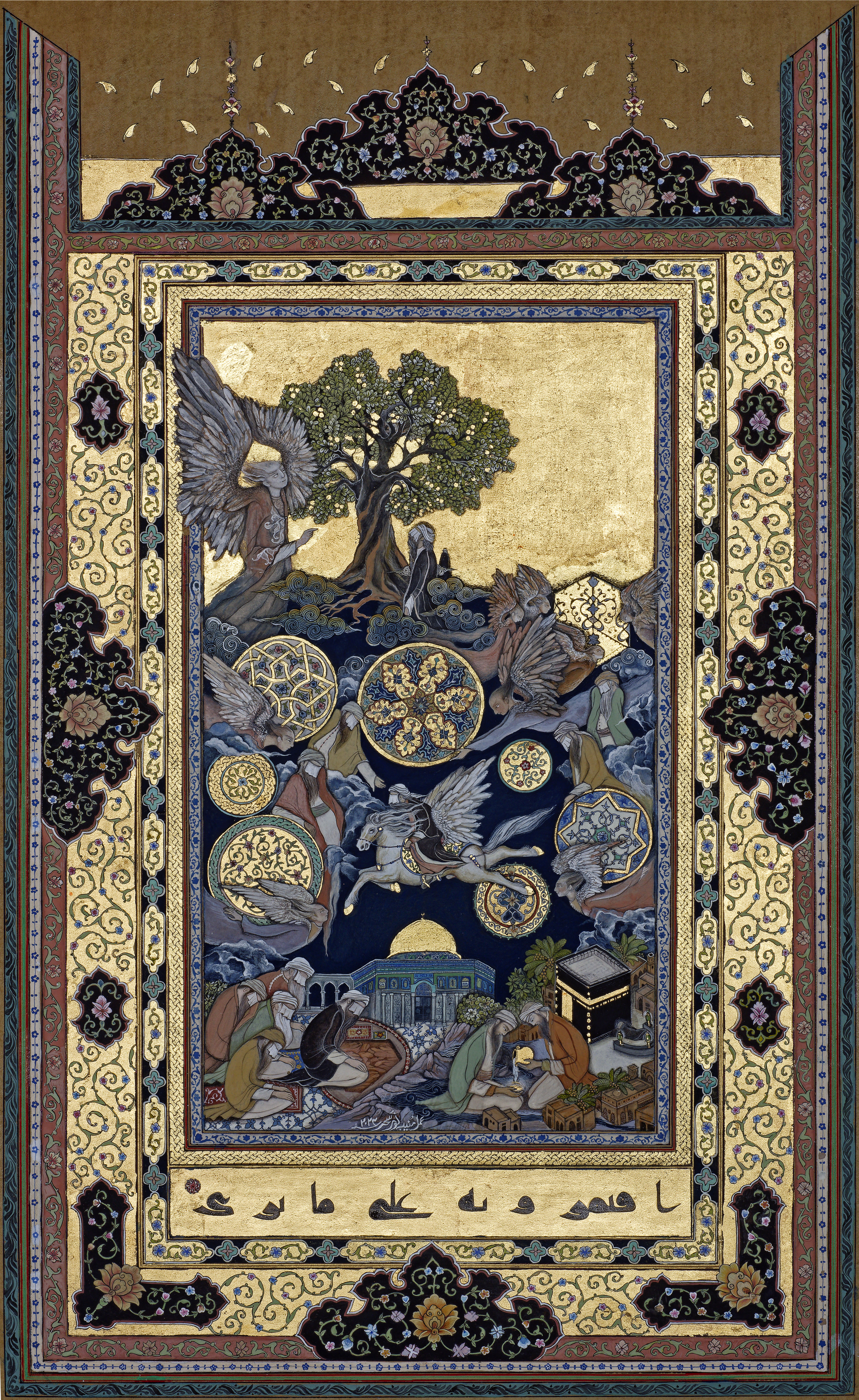
The artist has chosen the Isrā' wal-Mi'rāj · the Night Journey and Ascension of the Prophet Muhammad ﷺ · among the most cosmologically ambitious subjects in the canon of Islamic sacred art. Few events ask so much of a painter: the Isrā' calls for sacred terrestrial geography (Mecca and Jerusalem held together); the Mi'rāj calls for the heavenly spheres, the angelic world, the Sidrat al-Muntahā · the Lote Tree of the Utmost Boundary · and, hardest of all, the implied presence of what lies beyond it, which by definition cannot be depicted.
It is a subject that has tested painters across the tradition, because it requires not only technical command but theological literacy · an understanding of cosmology, of Sufi metaphysics, and of the sacred journey deep enough to make decisions that are spiritually coherent rather than merely beautiful. The work demonstrates that literacy clearly and consistently, and the appraisal that follows takes its ambition seriously enough to weigh both what it achieves and what it leaves unresolved.
The Three Cosmic Registers
How the picture plane is structured as a vertical cosmological ascent
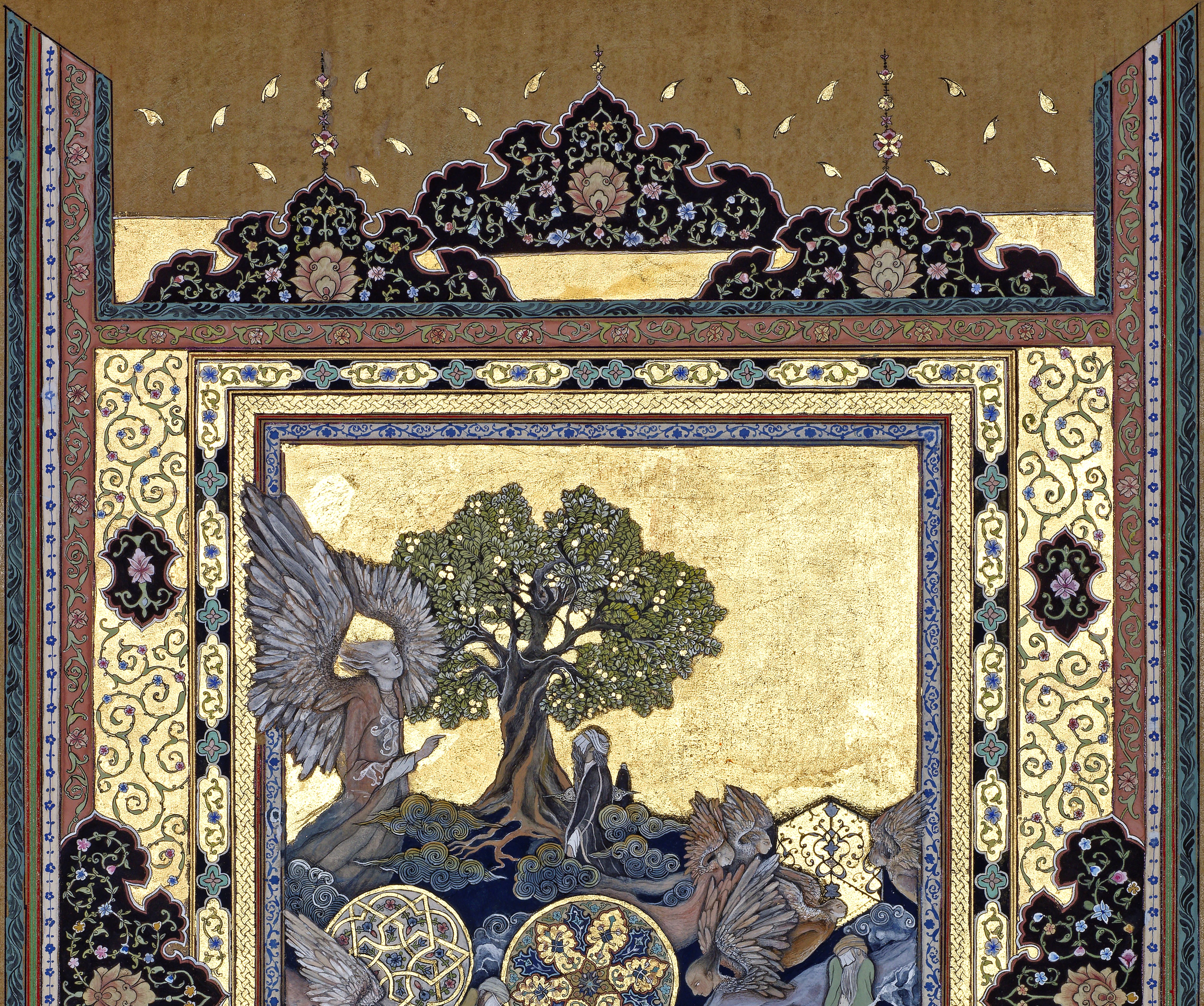
The work's defining structural decision is the organisation of the picture plane as a vertical cosmological axis · read from earth at the base, through the intermediary celestial world, to the divine threshold above. This is not only composition; it is statement. The direction of the Mi'rāj is upward, from density toward pure light, and the painting's axis enacts that direction in the eye before any single element has been consciously identified.
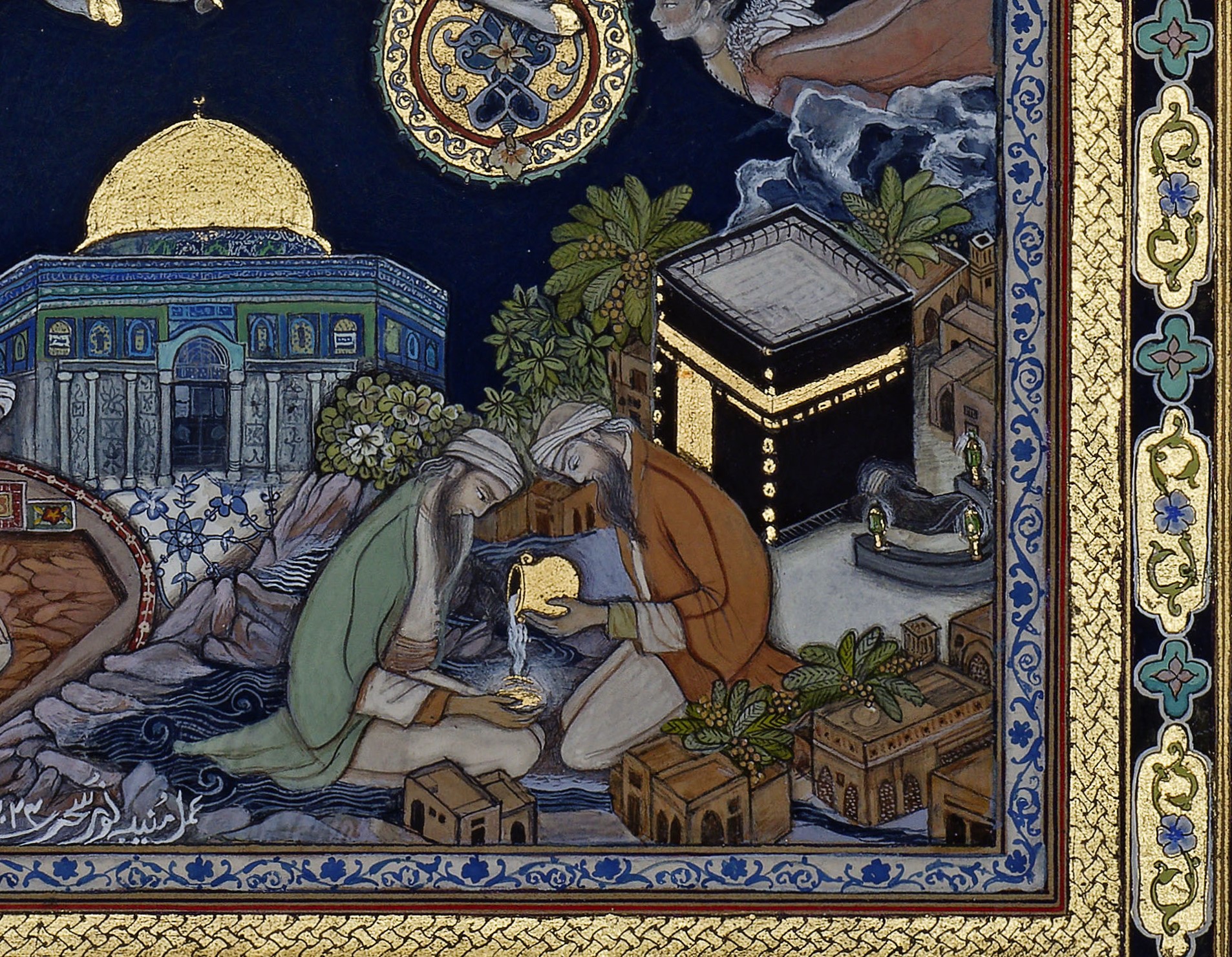
The base grounds the work in the sacred geography of the Isrā'. The Dome of the Rock and the precinct of al-Aqsa appear with the golden dome; the Ka'bah, draped in black, anchors the right. Holding both sanctuaries in a single register is a decision of theological completeness that many painters of this subject decline · the geography from Mecca to Jerusalem kept in one visual breath before the ascension begins.
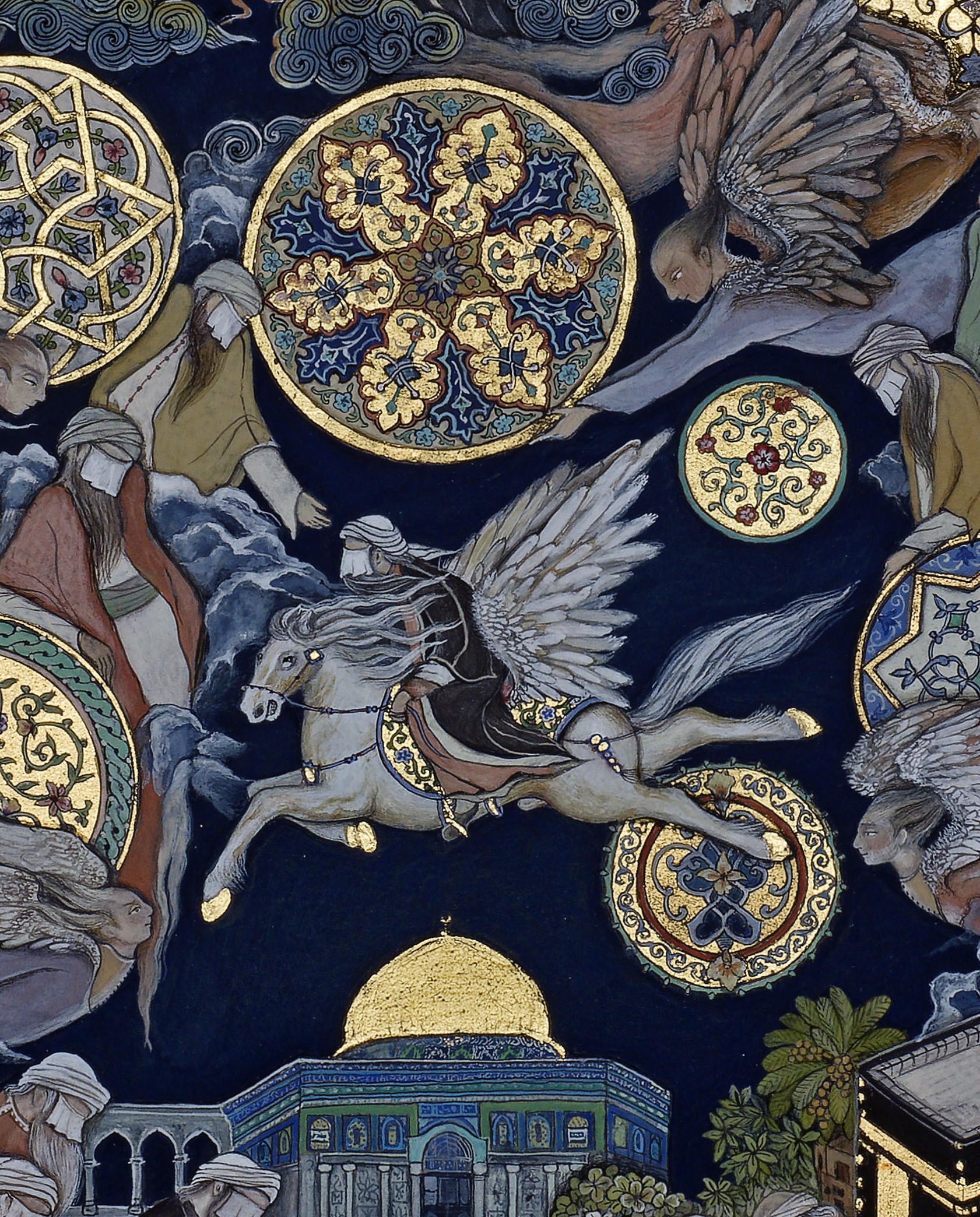
The deep lapis is the ghayb · the unseen. Here the work reaches its greatest visual intensity. Al-Burāq is shown in flight, white and luminous; the figure of the Prophet ﷺ is resolved through a consistent hierarchy of reverence · face withheld behind a veil rather than rendered in feature. The veiling marks rank: elevation shown not by demoting the angels but by the dignity of concealment itself.
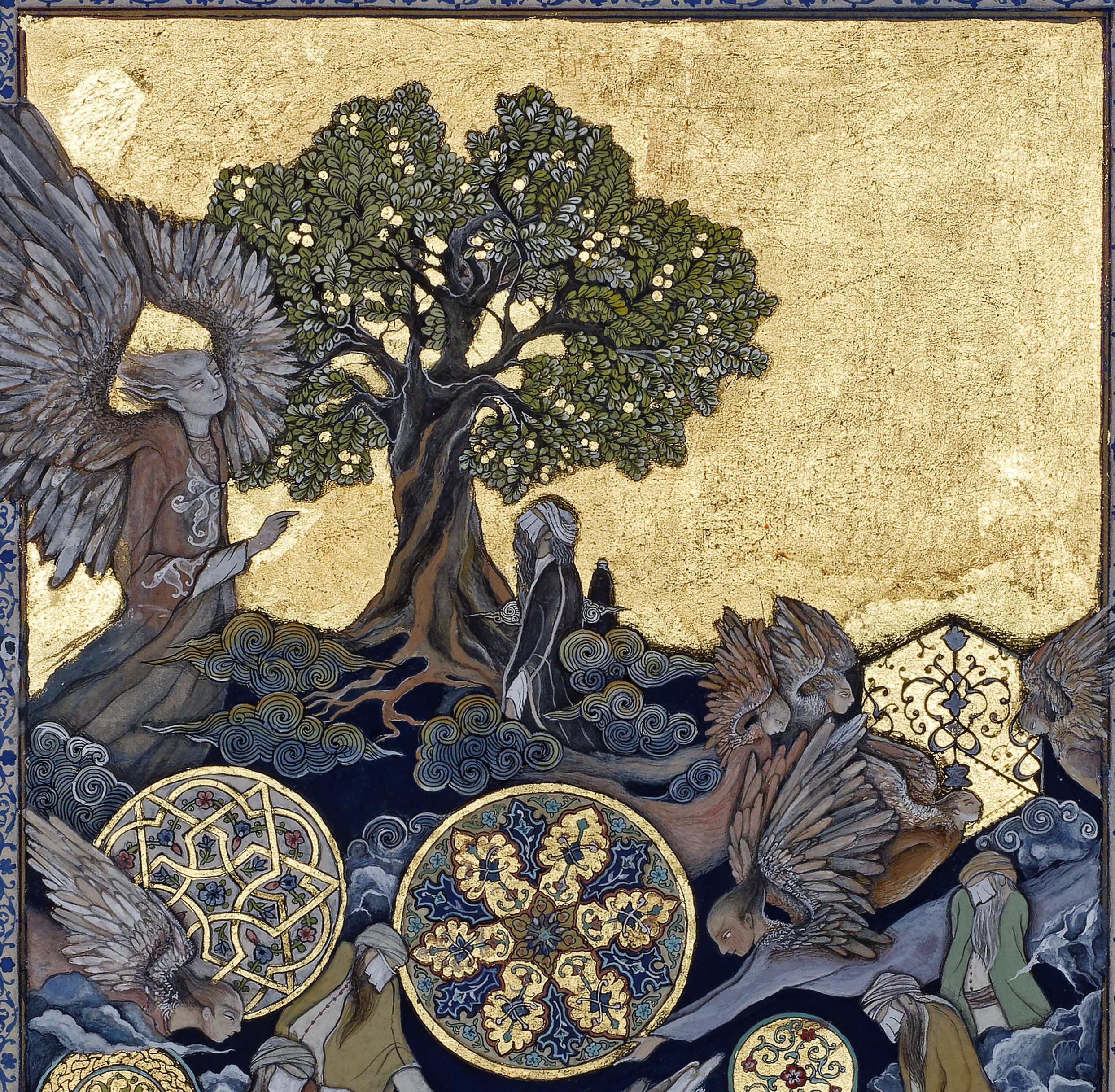
The night blue gives way · gradually, not abruptly · to a radiant gold ground: the nūr, divine light itself. Within it rises the great tree in living, particular greens against the flat gold. The contrast is exact: the last created, individual thing · a tree of distinct leaves and branches · set against the featureless luminosity of what lies beyond creation. Attending the threshold is Jibrīl, his great wings spread and his face veiled in keeping with the work's reverence hierarchy.
The Seven Spheres · Heavens of the Ascent
The work's most inventive element, and the cosmology that governs it
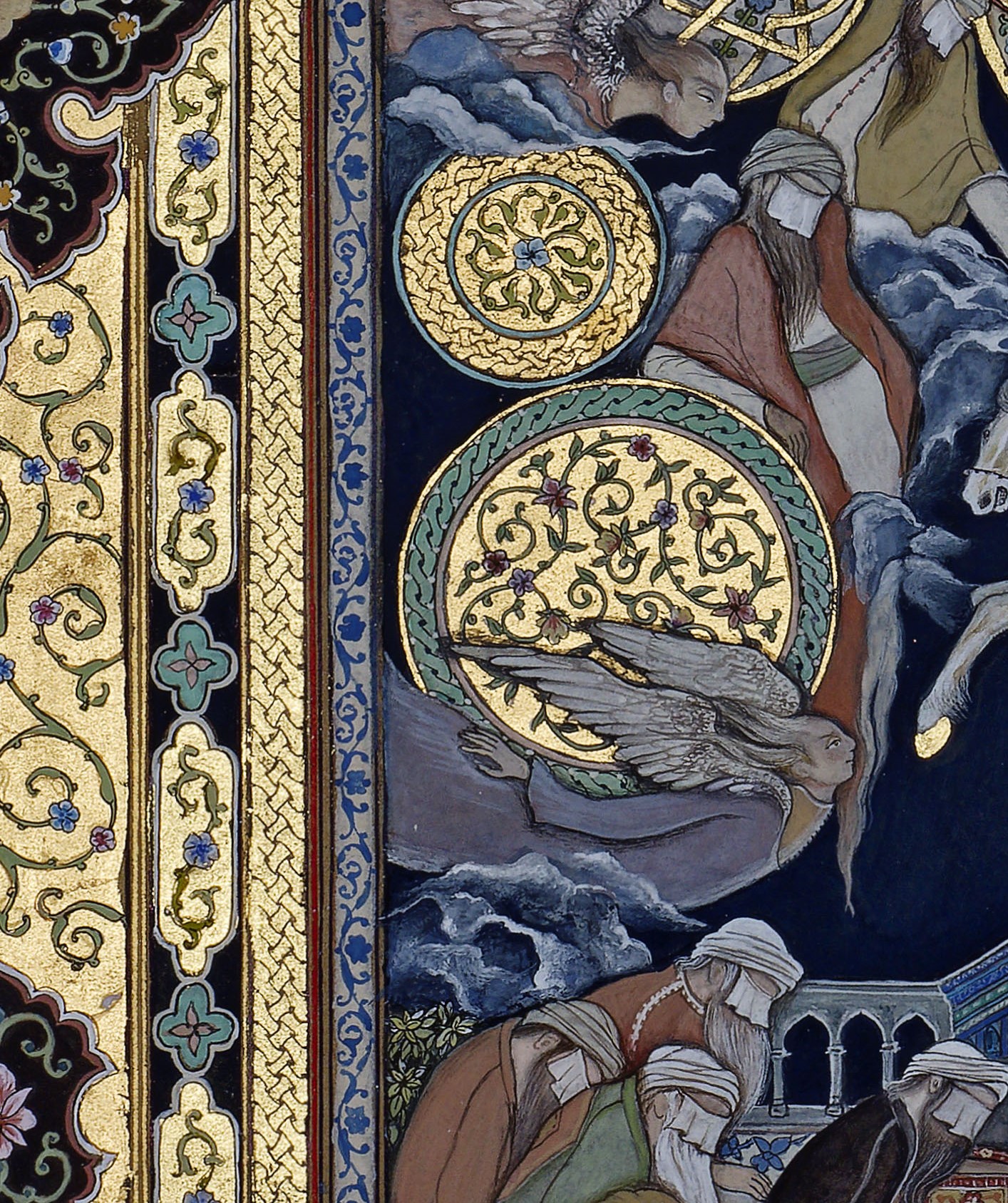
The golden medallions suspended in the celestial night are best understood as the seven heavens · the sab' samawāt of the Qur'an, each governed by its own order. Differentiating the spheres by pattern is an intelligent way to say that each heaven has its own register of being.
The Geometric Star Sphere
A complex star interlace from the girih system · the heaven of mathematical law, divine order expressed as proportion and symmetry.The Dense Arabesque Sphere
A field of concentrated islimi vine · the heaven of creative abundance, endless form proliferating from a single source. The most Persian of the spheres in spirit.The Central Rosette Sphere
A symmetrical bloom radiating from one point · the shamsa principle: unity at the centre, multiplicity unfolding outward in measured symmetry.The Floral Field Sphere
A scatter of individual khataei blossoms with no single dominant centre · a heaven of generosity, each creature equally present and equally sustained.Together the spheres form a visual theology of the heavens · each a different face of divine order, all luminous against the same lapis night. Rendered in gold on blue, they read as light-sources, as though the heavens themselves generate the radiance that, in the upper register, resolves into the undifferentiated gold of the divine.
The Illumination · Tazhib as Framing
Reading the border work as active spiritual structure
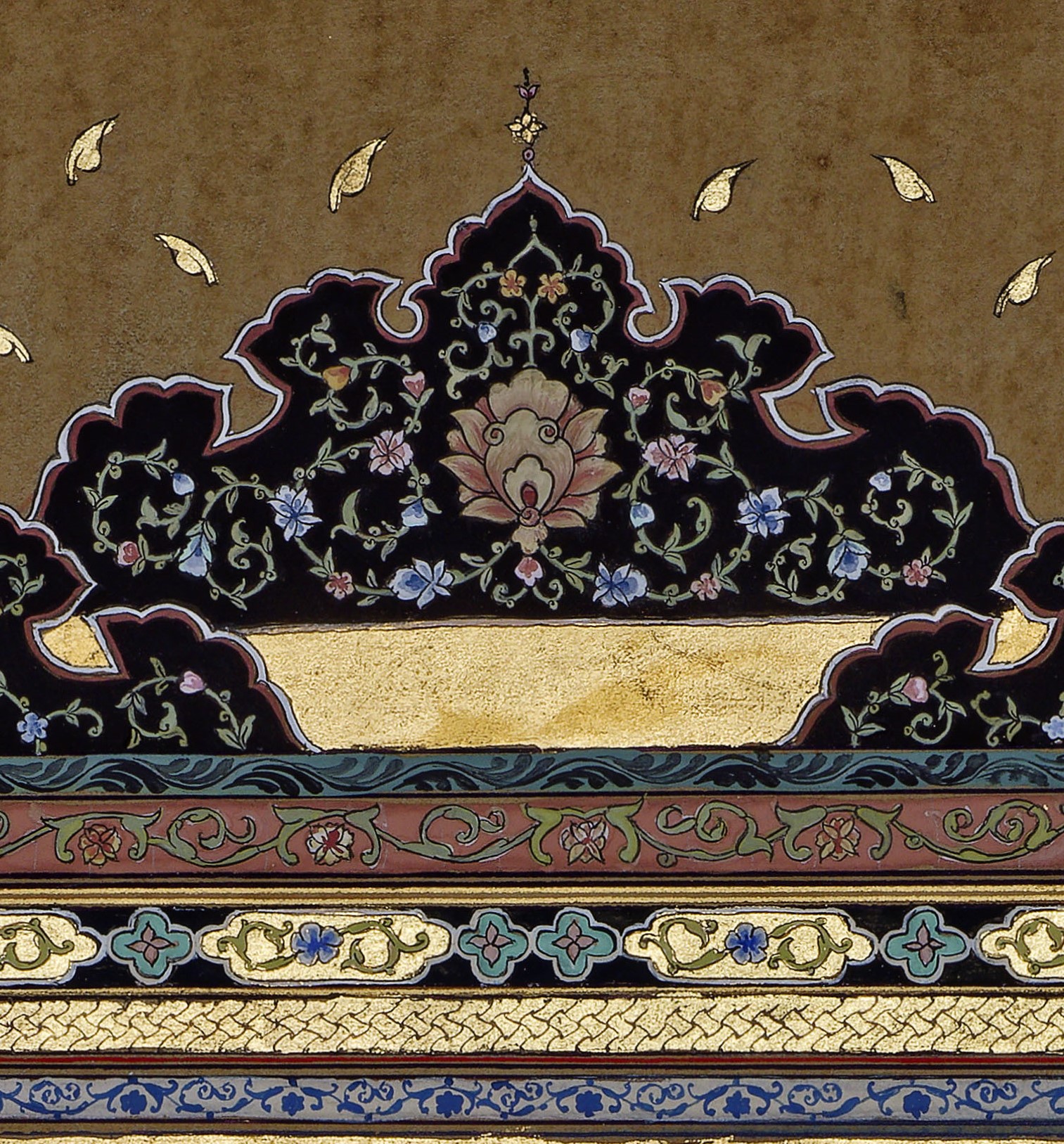
The outermost border sets large jewel-toned lotus forms · burgundy, blue, gold · against a near-black ground, recalling the Safavid morassa' idiom. The dark ground carries meaning: it frames the painting in the same night that fills the celestial register within, the ghayb surrounding the whole as mystery surrounds creation.
The wide band of islimi on gold performs the spiritual function often ascribed to the arabesque: the continuous vine prevents the eye from fixing anywhere, keeping attention in motion · mirroring a soul drawn always further upward.
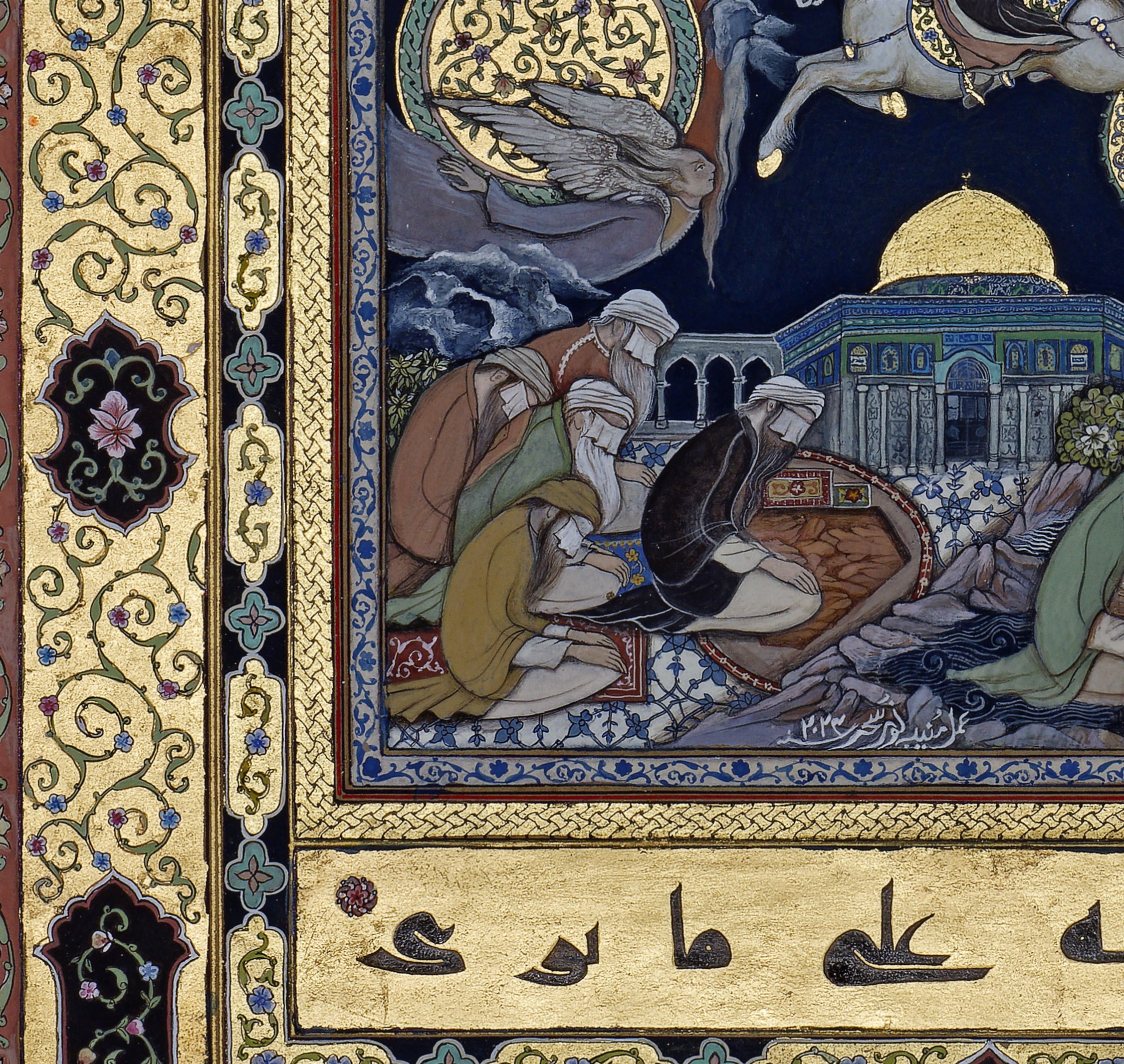
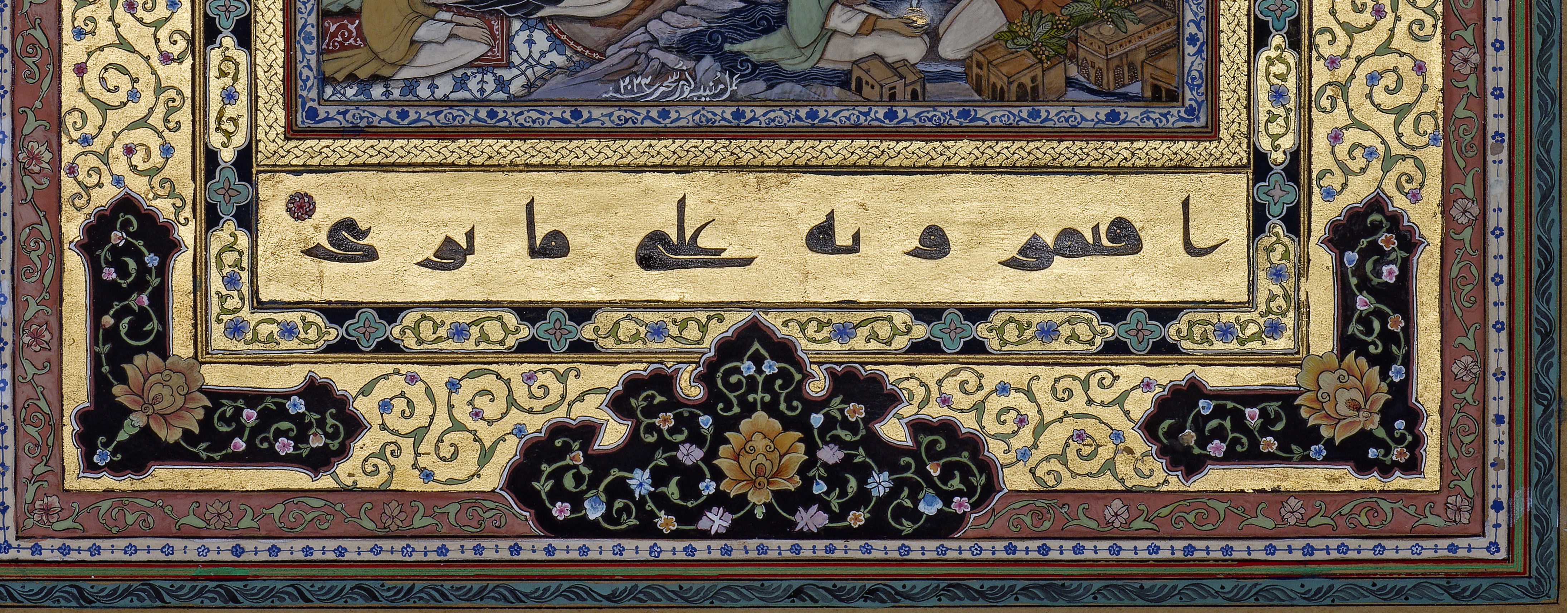
The black-on-gold band beneath the image is chosen with precision: Qur'an 53:12 · afa-tumārūnahu ʿalā mā yarā, "Will you then dispute with him concerning what he saw?" · drawn from Sūrah an-Najm, the very chapter that names the Sidrat al-Muntahā (53:14), the tree crowning the painting. The image and its caption stand in the relation of sight to its proof. Executed in early Kufic · the hand of the first written Qur'ans · the word beneath lends the work the authority not of the atelier but of the codex.
Colour Theology
Each dominant hue as a carrier of spiritual meaning
The palette reads as a coherent colour theology, each dominant hue rooted in Islamic visual tradition. The governing pairing of burnished gold and lapis blue is also the historically correct register for a celestial subject · the palette of Timurid and early Safavid heavens.
| Colour | Term | Spiritual Meaning | |
|---|---|---|---|
| Gold | Nūr · divine light | The uncreated light; permanence; the eternal. The light the journey ascends toward, enacted around the world of forms. | |
| Deep Lapis | Ghayb · the unseen | The infinite mystery; the night of the journey; the celestial expanse through which the ascent passes. | |
| White | Bayāḍ · purity | Burāq is entirely white · the threshold-creature, rooted in neither world and able to move between them precisely for that reason. | |
| Green | Khuḍra · paradise | The Sidrat al-Muntahā · the last living thing before the uncreated · is green, the colour of paradise. Its naturalness against the gold makes it the most poignant note in the work. | |
| Black | Sawād · the terrestrial | The Ka'bah, black-draped and earth-anchored · sacred concentration rather than negation. | |
| Burgundy | Aḥmar · majesty | Carried in the jewelled outer border · the colour of sacred authority, framing the celestial journey with appropriate dignity. |
Considered Decisions
Choices that distinguish the work as theological painting, not only accomplished craft
Tradition, Synthesis & Open Questions
Where the work stands in the lineage, and the problems it is still resolving
The work draws deeply from the Persian-Safavid tradition: the islimi borders, the jewelled dark-ground frame, the toranj medallion, the gold ground, and the deep lapis celestial night. From the Mughal tradition come the warmth and naturalism of the modelled figures, the volumetric steed, and the organic landscape below. The Ottoman inflection is clearest in the frontal, legible treatment of the holy architecture · rendered with an almost documentary clarity.
This breadth is the work's signature, and its principal open question. A classical master worked within a single optical grammar, and the unity of that grammar is part of what makes those pages feel inevitable. This painting instead brings three grammars into one field · and at the joints, where flat illumination meets atmospheric modelling, the idioms can be felt negotiating rather than fully fusing. This is the characteristic situation of the serious contemporary revivalist: enormous, well-researched knowledge, working toward an organic rather than an anthological unity.
Frame and field. The border programme is dense and high in contrast. In classical album work the margin is deliberately tuned down relative to the image. Here the frame is strong enough to compete with the celestial event it serves · a matter of pitch rather than of skill, and the only question that remains for a work that has already answered so many harder ones.
Critical Assessment
This is a work of real ambition, sustained research, and considerable labour, and it succeeds where many attempts at the Mi'rāj do not: it is structured by theology, not merely decorated with it. The vertical axis, the three registers, the dual sacred geography, the seven heavens, the green of the Sidra against the gold, the arabesque that never rests · each is grounded in the cosmological tradition and executed with evident understanding of what it means.
The painting shows an artist working from inside the theological vocabulary · making decisions as a thinker about sacred cosmology, not only as a craftsman executing a familiar subject.
Where it is still reaching is in the unity of its optical language · the ease with which its flat, iconic passages and its modelled, atmospheric ones share a single field. This is not a deficiency of skill; it is the problem of a maker who has already earned the right to be measured against the masters. That the work raises it at all is the surest sign of how far its research and its hours have carried it.
• Isrā' · the Night Journey: from the Masjid al-Ḥarām in Mecca to the Masjid al-Aqsa in Jerusalem.
• Mi'rāj · the Ascension: from Jerusalem through the seven heavens to the divine presence.
• Al-Burāq · the luminous winged steed of the journey; white, of a size between donkey and mule.
• Sidrat al-Muntahā · the Lote Tree of the Utmost Boundary, at the limit of the seventh heaven, beyond which no created being may pass.
• Sūrah an-Najm (53) · "The Star"; the Qur'anic chapter narrating the Ascension vision and naming the Sidrat al-Muntahā. Verse 12 affirms the truth of what the Prophet ﷺ saw.
• Nūr · divine light, expressed through gold across all three illumination traditions.
• Ghayb · the unseen world; the realm of angels and of all beyond ordinary perception.
• Toranj · the oval or circular medallion of Persian illumination; here figuring the heavenly spheres.
• Islimi · the arabesque spiral vine; one source flowing through endless form.
• Girih · the geometric strapwork-and-star system of Islamic ornament.
• Morassa' · 'jewelled'; the Safavid illumination style simulating set gemstones, used in the outer border.
• Tawḥīd · Divine Unity; the metaphysical principle by which the divine exceeds any frame.